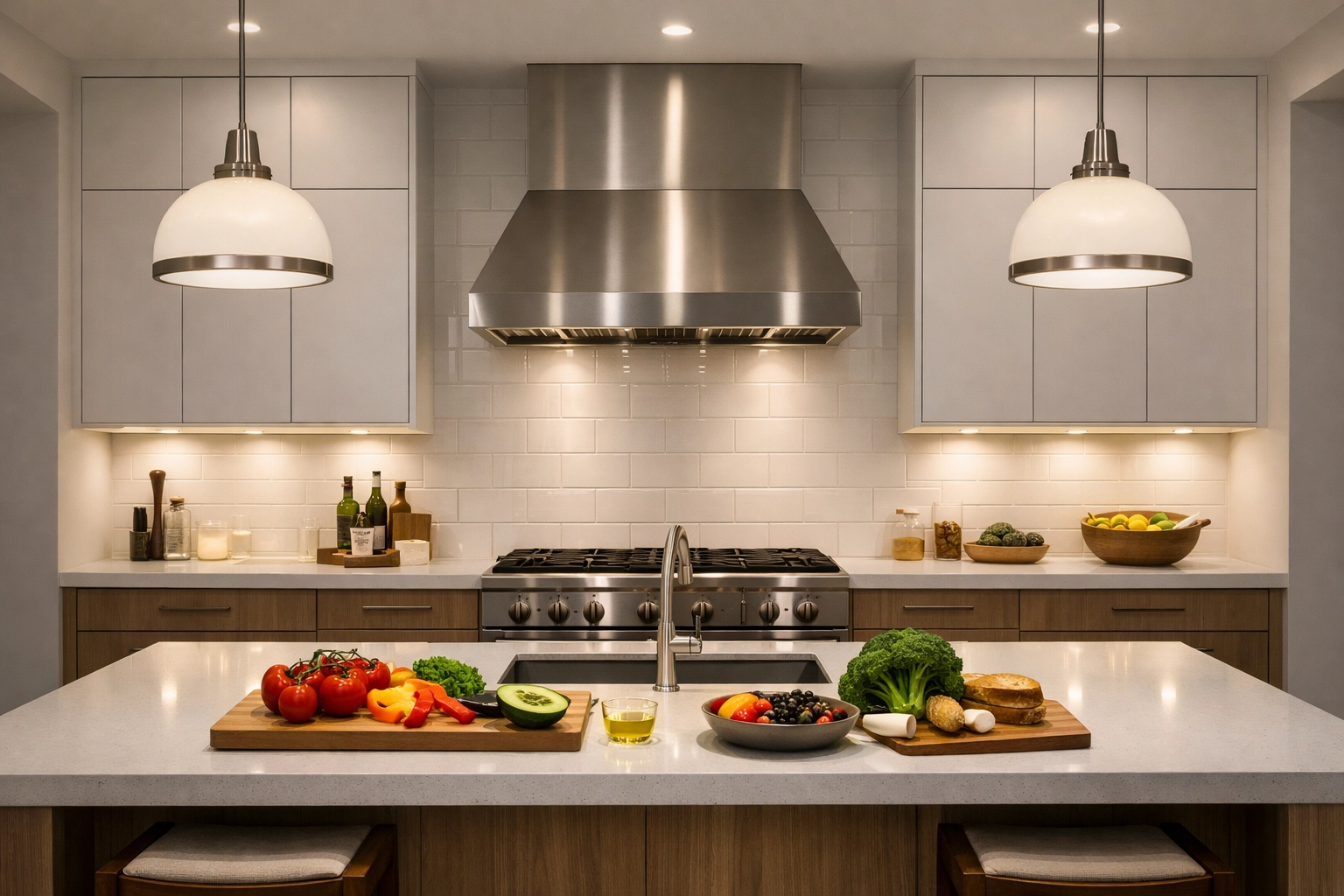
Lighting: The Essential Final Touch. In the world of high-end kitchen design and custom cabinetry, lighting is far more than a utility—it is the element that defines the atmosphere and functionality of your home. At SOUL LED Tech + Design, we believe in precision. We believe in handmade, custom quality design that originates right here in Canada.
However, even the most beautiful kitchens can be undermined by poor lighting choices. Under cabinet lighting is one of the most requested features in modern renovations, yet it is also where most DIYers and even some professionals stumble. From incorrect placement to poor power planning, these errors can lead to a kitchen that feels cluttered, dark, or—worst of all—unprofessional.
Explore the most common pitfalls and discover how to elevate your space with expert solutions.
1. The "Wall-Hugging" Placement: Lighting the Backsplash Instead of the Counter
Elevate Your Workspace: Position Matters. One of the most frequent mistakes is mounting the LED strips too far back against the wall. When you place your lighting at the rear of the cabinet, you are essentially illuminating the backsplash and the corner where the wall meets the counter. This creates harsh glare on the wall and leaves the front half of your workspace in shadow.
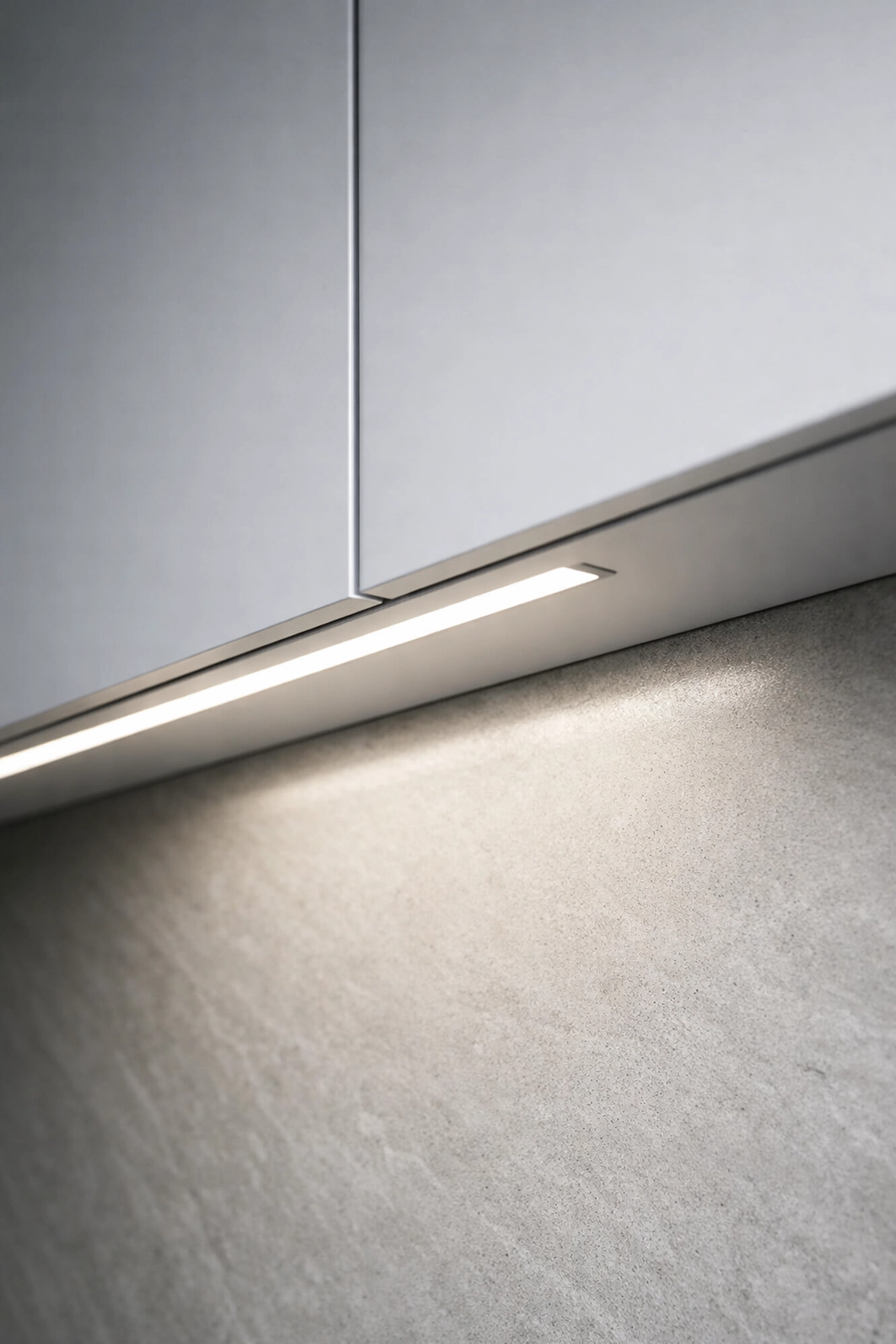
The Fix: Redefining Lighting Geometry. To achieve a perfectly illuminated countertop, mount your LED channels closer to the front of the cabinet—just behind the front lip or valance. This ensures the light is centered over the area where you actually perform tasks, like chopping vegetables or reading recipes. For an even more professional look, use our premium aluminum channels found in the SOUL LED Shop to angle the light slightly toward the back.
2. The "Spotted" Look: Ignoring Diode Imaging
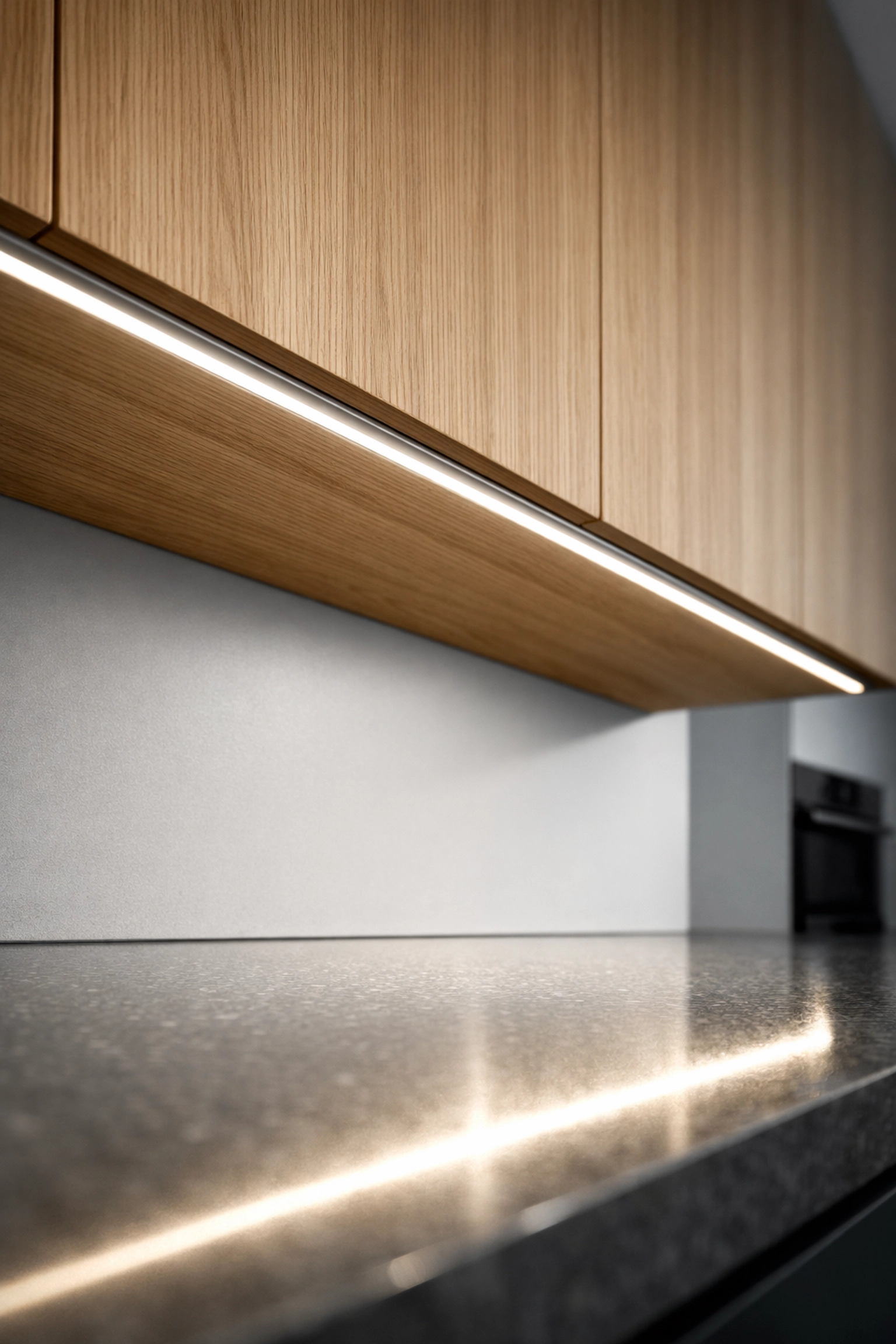
Refining Aesthetics: Achieve the Dot-Free Glow. There is nothing that ruins a high-end kitchen aesthetic faster than seeing individual "dots" of light reflected on a polished quartz or granite countertop. This is known as "spotting" or "diode imaging." It occurs when low-quality LED strips are used without proper diffusion.
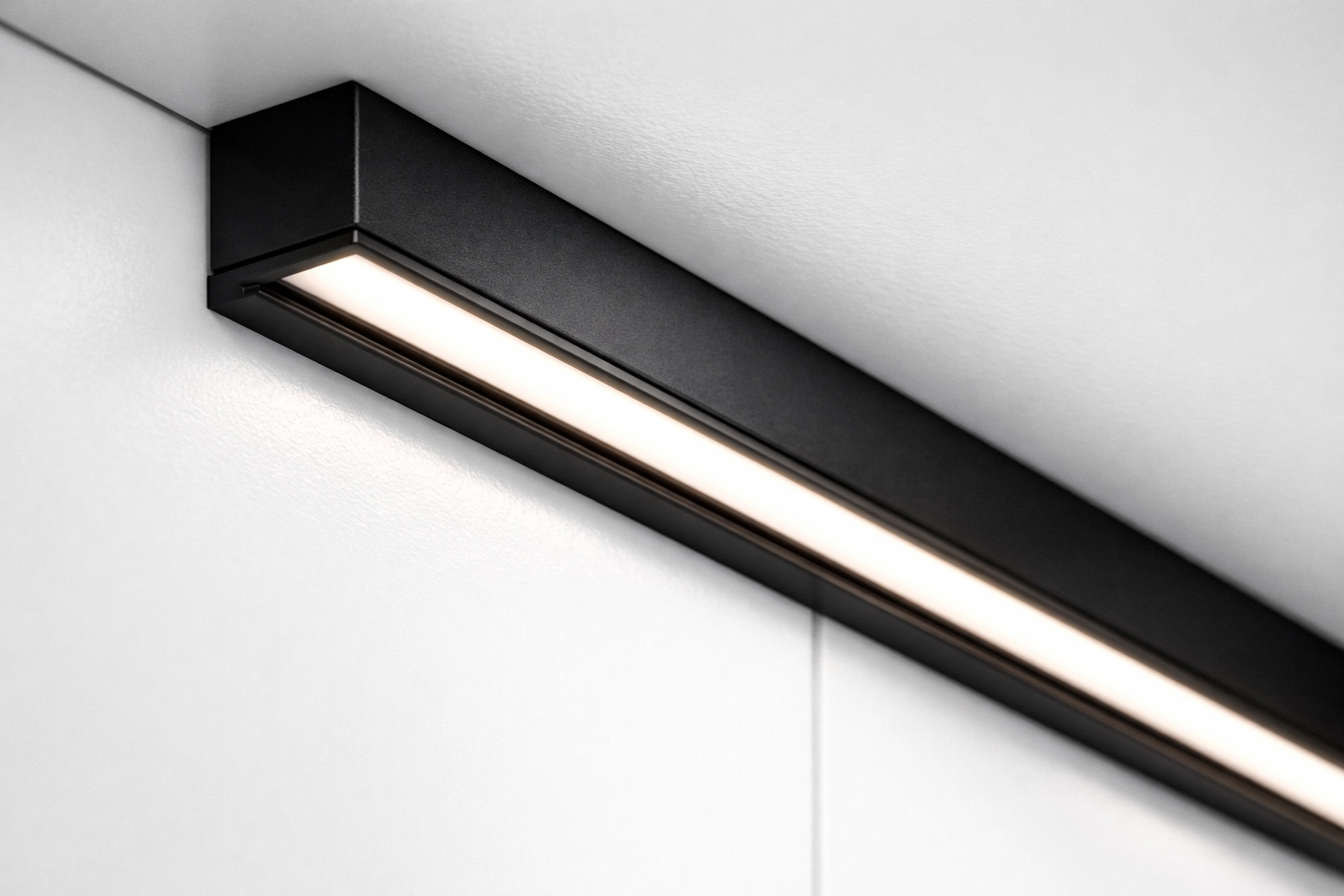
The Fix: Crafted to Perfection. The solution is simple: always use an aluminum profile with a frosted lens. Our SOUL LUX and SOUL AURA series are designed specifically to diffuse light evenly, creating a seamless "neon" glow that eliminates hot spots. When combined with high-density LED strips, the result is a smooth, continuous line of light that speaks to true craftsmanship.
3. Color Temperature Clashes: The 3000K vs. 5000K Debate
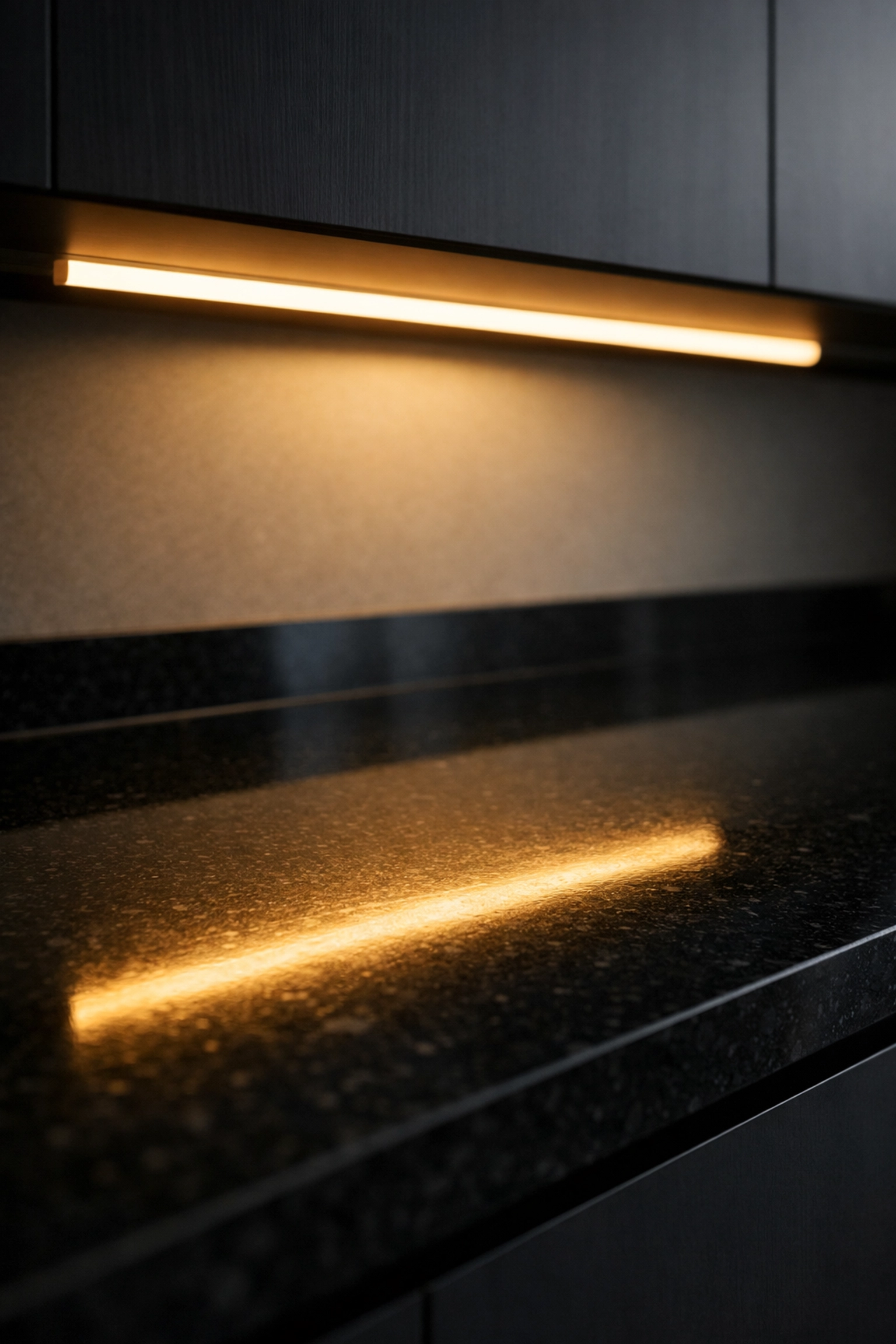
Define Your Ambiance: Consistency is Key. Imagine a warm, wood-toned kitchen suddenly washed in a sterile, blue-tinted hospital light. This is the result of choosing the wrong color temperature (Kelvin). Many homeowners grab a box of "Cool White" LEDs thinking brighter is better, only to find it clashes with their home’s warm interior.
The Fix: Harmonizing Industry Standards. For most residential kitchens, 3000K (Warm White) is the gold standard—it’s inviting and complements natural wood and warm stone. If you prefer a more modern, crisp look without the blue tint, 4000K (Natural White) is the way to go. Whatever you choose, ensure it matches the other lights in your open-concept space. Discover more about our color options on our À propos de nous page.
4. Overloading the Driver: The 80% Rule
Powering Excellence: Safety First. Under cabinet lighting requires a driver (transformer) to convert your home’s 120V power into 12V or 24V. A common error is calculating the exact wattage needed and buying a driver that matches it perfectly. For example, if you have 60W of LEDs, you buy a 60W driver. This leads to overheating and premature failure.
The Fix: Catalyzing Longevity. Always follow the 80% rule: your total LED wattage should never exceed 80% of the driver’s capacity. If your lights pull 60W, you should use at least a 75W or 100W driver. This ensures the system runs cool and lasts for years. Our handmade Canadian systems are built to withstand the rigors of daily use, provided they are powered correctly.
5. Visible Wire Spaghetti: Poor Concealment
Driving Change: Professional Integration. Nothing detracts from custom cabinetry like a tangled mess of wires visible from the dining table. Exposed wires are not just an eyesore; they are a sign of poor planning.
The Fix: Seamless Installations. Planning is essential. If you are in the renovation phase, run your low-voltage wires inside the walls or behind the cabinets before the backsplash is installed. If the kitchen is already finished, use small wire-molding or tuck wires into the corners of the cabinets. For those seeking a truly integrated look, our LED linear installation guide offers deep insights into sleek efficiency.
6. Incompatible Dimming: The Flicker Fiasco
Mastering Control: Smooth Transitions. You’ve installed your beautiful lights, but when you try to dim them, they flicker or buzz. This usually happens because the LED driver is not compatible with the wall dimmer switch.
The Fix: Integrated Solutions. Ensure you are using a "Dimmable Driver" that is compatible with TRIAC, ELV, or MLV dimmers (depending on your home’s setup). At SOUL LED, we provide specialized advice to ensure your SOUL LINK or other lighting systems dim perfectly from 100% down to 1% without a single flicker.
7. Choosing "Off-the-Shelf" Over Custom Quality
Redefining Standards: The Value of Handmade. It is tempting to buy a cheap "plug-and-play" kit from a big-box store. However, these mass-produced items often use low CRI (Color Rendering Index) chips, meaning your food and countertops will look dull and grey rather than vibrant and true-to-life.
The Fix: Authorized Perfection. Invest in high-CRI, handmade lighting solutions. Our products are proudly made in Canada, offering a level of durability and color accuracy that mass-market kits simply cannot match. When you choose SOUL LED, you are choosing a Wholesale Program quality that professionals trust.
7 Erreurs que Vous Commettez avec l'Éclairage Sous les Armoires (Et Comment les Corriger)
L'Éclairage : La Touche Finale Essentielle. Dans l'univers de la conception de cuisines haut de gamme et de l'ébénisterie sur mesure, l'éclairage est bien plus qu'une simple utilité—c'est l'élément qui définit l'atmosphère et la fonctionnalité de votre demeure. Chez SOUL LED Tech + Design, nous croyons en la précision. Nous croyons en une conception de qualité artisanale et personnalisée, originaire d'ici même, au Canada.
Cependant, même les plus belles cuisines peuvent être compromises par de mauvais choix d'éclairage. L'éclairage sous les armoires est l'une des caractéristiques les plus demandées dans les rénovations modernes, pourtant c'est aussi là que la plupart des bricoleurs et même certains professionnels trébuchent.
Explorez les pièges les plus courants et découvrez comment sublimer votre espace grâce à des solutions d'experts.
1. Le Placement "Contre le Mur" : Éclairer le Dosseret au lieu du Comptoir
Sublimez Votre Espace de Travail : L'Importance de la Position. L'une des erreurs les plus fréquentes consiste à monter les rubans LED trop loin vers l'arrière, contre le mur. Lorsque vous placez votre éclairage à l'arrière de l'armoire, vous illuminez essentiellement le dosseret. Cela crée un éblouissement intense sur le mur et laisse la moitié avant de votre plan de travail dans l'ombre.
La Solution : Redéfinir la Géométrie de l'Éclairage. Pour obtenir un comptoir parfaitement illuminé, montez vos profilés LED plus près de l'avant de l'armoire—juste derrière le bandeau décoratif. Cela garantit que la lumière est centrée sur la zone où vous travaillez réellement.
2. L'Effet "Pointillé" : Ignorer l'Imagerie des Diodes
Raffiner l'Esthétique : Obtenez un Éclat sans Points. Rien ne gâche plus l'esthétique d'une cuisine de luxe que de voir des "points" lumineux individuels se refléter sur un comptoir en quartz ou en granit poli. C'est ce qu'on appelle l'imagerie des diodes.
La Solution : Créé pour la Perfection. La solution est simple : utilisez toujours un profilé en aluminium avec une lentille givrée. Nos séries SOUL LUX et SOUL AURA sont conçues spécifiquement pour diffuser la lumière uniformément, créant une ligne de lumière continue et fluide.
3. Conflit de Température de Couleur : Le Débat entre 3000K et 5000K
Définissez Votre Ambiance : La Cohérence est la Clé. Imaginez une cuisine aux tons de bois chaleureux soudainement lavée par une lumière d'hôpital bleutée et stérile. C'est le résultat d'un mauvais choix de température de couleur (Kelvin).
La Solution : Harmoniser les Standards de l'Industrie. Pour la plupart des cuisines résidentielles, le 3000K (Blanc Chaud) est la norme d'or—c'est invitant et cela complète le bois naturel. Si vous préférez un look plus moderne et net, le 4000K (Blanc Naturel) est le choix idéal.
4. Surcharge du Pilote : La Règle des 80%
Alimenter l'Excellence : La Sécurité Avant Tout. Une erreur courante consiste à acheter un pilote (transformateur) dont la puissance correspond exactement à la puissance totale de vos LED. Cela entraîne une surchauffe et une défaillance prématurée.
La Solution : Catalyser la Longévité. Suivez toujours la règle des 80% : la puissance totale de vos LED ne doit jamais dépasser 80% de la capacité du pilote. Si vos lumières consomment 60W, utilisez au moins un pilote de 75W ou 100W.
5. Des Fils en "Spaghetti" : Une Mauvaise Dissimulation
Propulser le Changement : Intégration Professionnelle. Rien ne dégrade plus l'ébénisterie sur mesure qu'un fouillis de fils visibles depuis la table à manger.
La Solution : Installations Fluides. La planification est essentielle. Si vous êtes en phase de rénovation, passez vos fils basse tension à l'intérieur des murs avant d'installer le dosseret. Pour un look vraiment intégré, consultez notre galerie de projets sur notre page de services.
6. Gradation Incompatible : Le Fiasco du Scintillement
Maîtriser le Contrôle : Transitions Douces. Vous avez installé vos magnifiques lumières, mais lorsque vous essayez de les tamiser, elles scintillent ou bourdonnent. Cela se produit généralement parce que le pilote LED n'est pas compatible avec le gradateur mural.
La Solution : Solutions Intégrées. Assurez-vous d'utiliser un pilote graduable compatible avec votre système domestique. Chez SOUL LED, nous fournissons des conseils spécialisés pour garantir que vos systèmes, comme le SOUL LINK, fonctionnent parfaitement.
7. Choisir le "Prêt-à-Porter" au lieu de la Qualité Sur Mesure
Redéfinir les Normes : La Valeur du Fait Main. Il est tentant d'acheter un kit bon marché dans une grande surface. Cependant, ces articles manquent souvent de fidélité des couleurs (IRC), ce qui rend vos aliments et vos comptoirs ternes.
La Solution : Perfection Autorisée. Investissez dans des solutions d'éclairage à IRC élevé, fabriquées à la main. Nos produits sont fièrement fabriqués au Canada, offrant une durabilité que les kits de grande distribution ne peuvent tout simplement pas égaler.